一、people
1、people 泛指“人”,“人们”,【men,women and children】,没有复数形式,是集合名词。用作主语时,其谓语动词须用作复数形式。
继续阅读“people”
余生图志
《民法典》,光一个“法”字,就出现了千次以上,“法律”一词300多次,“依法”则有150多次。在英译本里,是如何翻译的呢?乍一看,有law,the law,the civil law ,the laws,other laws,等等,兼顾搭配和句法,都翻译对了吗?核心在于一个问题:law与冠词的关系。其实,有老先生早就系统地对此作了分析。暂且按下不提。
《民法典》搞了一个英文译本,咱要学习学习。初读序言,味道很怪。既然是“翻译”,先取其首:translation。
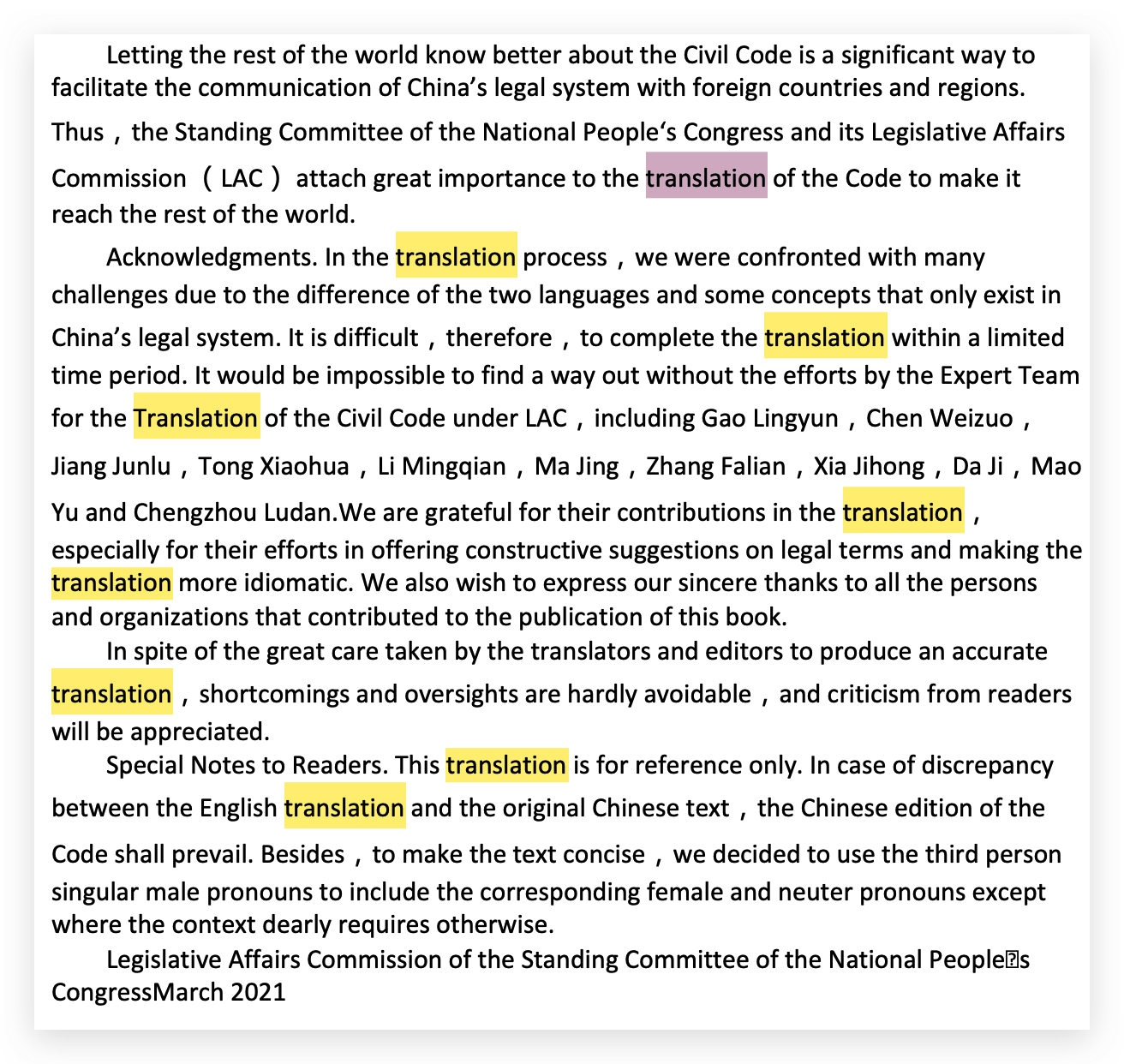
中文说“翻译”,英文中有不同的表达:
1. translating(翻译过程):进行翻译的过程,是活动而不是有形的物体;
2. a translation(译作):翻译过程的产品,即译语语篇;
3. translation (翻译): 一个抽象概念,包括翻译过程和该过程的产品。
4. rendering :翻译(行为)。
5. renderings:译文。
6. version:译文,版本。
两相对照,正误可辨。说是为了idiomatic,不如先解决readability吧。
离婚协议中资助条款意思表示真实的认定问题
内容摘要:离婚协议中资助条款的效力在司法审判实践中已大多被认定为有效,意思表示真实是判定资助条款有效的核心要素。婚姻关系常存有伦理道德感性直觉与立法规定理性规则间的冲突。离婚协议中的资助条款,当事人意思表示真实之下的潜在意思多出于伦理常情、风俗习惯的考量。对离婚协议中资助条款效力的认定,意思表示真实的判定应结合其本身的潜在意思表示,予以适当的限缩,匹配期限规则和资助方穷困抗辩权,兼顾离婚当事人对财产处分的立法理性和情感感性,以维护家庭伦理,尊重婚姻本质。
关键词:离婚协议,资助条款,意思表示真实
On The Validity of Clauses for Financial Support Based on Genuine Intention
Abstract: In dissolution proceedings, a judge tends to grant more conclusive effect to any clauses for financial support in a divorce agreement, depending upon the question whether the supporting intention expressed by the contracting parties is genuine. The conflict between moral principles and legal rules arises when the marital relation has been carried into adjudication .While reaching such a clause, the parties to a separation agreement probably fail to manifest their underlying intention stemmed from normal human feelings or social custom. In case of disposition of the property in line with their wishes and statutory provision, the validity of the clauses depends on party's intention, both the underlying concern and the explicit manifestation (the latter limited to condensed interpretation), subject to the duration rules applied to judicial proceedings or the poverty state counterplead right executed by the supporter according to legal reasons. In so doing,it embodies family ethics and the essence of marriage.
Key words: divorce agreement, financial support clauses, the intention expressed is genuine

   散文翻译,似乎不难。难,就难在作者本来就在“信口开河”,译者一厢情愿自言自语就成了“胡说八道”了。
   鲁迅先生著有《秋夜》,就是那一篇“一株是枣树,还有一株也是枣树”的,其中有一段:后窗的玻璃上丁丁地响,还有许多小飞虫乱撞。不多久,几个进来了,许是从窗纸的破孔进来的。他们一进来,又在玻璃的灯罩上撞得丁丁地响。一个从上面撞进去了,他于是遇到火,而且我以为这火是真的。两三个却休息在灯的纸罩上喘气。那罩是昨晚新换的罩,雪白的纸,折出波浪纹的叠痕,一角还画出一枝猩红色的栀子。
   此处存疑有二:树人家的窗户到底是玻璃的还是纸糊的?这个灯罩到底是玻璃的还是纸糊的?
   要考证似乎也不难,这个比红学专家考证大观园的厕所容易多了。此处按下不提。
1、玻璃上丁丁地响,怎么个“响法”?
(1)杨译:A pit-a-pat sounds from the glass of the back window
(2)徐译:There are tinkling noises on the glass of the rear window
(3)许评
A、noise 和sound都是一般用语,指耳的音感。sound是最普通用语,指人们感觉到的各式各样的声音,如as well as soft sounds of nature (天籁之音),而 noise 用法专一,表示“噪音”,“吵闹声”(unwanted, unpleasant or confused sound),主要带有不快的主观情绪,除此之外,还可以表示环境音,或者某种可察觉和感触的松散微弱的声音,类似白噪音,如the soothing noise of water falling 。结合语境,文中小青虫并非批判和厌恶之物,不宜用 noise 。
B、以声源论,from显然比on准确。
2、窗纸的破孔有几个?
(1)杨译:presently,some get in,no doubt through a hole in the window paper
(2)徐译:Before long, a few of them get in, perhaps through the holes in the window's paper panel
(3)许评
A、以周先生的心思揣摩之,窗户上的破孔应该是不曾发现的,多乎哉?此处着墨于进出之道,a hole泛指也罢,杨译却用了坚决的“no doublt”。the holes ,意在多,似乎又知晓其所在,徐译却用了“perhaps”。
B、既然是从“窗纸破孔”进来,哪又何必用panel?panel多用板材,镶嵌的是一个面,徐译不妥。
3、纸糊的灯罩有几个角呢?
(1)杨译:and painted in one corner is a spray of blood-red gardenias
(2)徐译:with snow-white paper folded into a wave-like pattern and a spray of scarlet-colored gardenia painted on one of its corners
(3)许评
A、 one of its corners非常不妥,这里又不是八角灯笼,既无几何学上的“角”的概念,又无对应数量问题,这里的corner仅表示某处,系泛指,可借用一例说明:In every corner of the world there is always something we can do to make a difference. 天地之间,皆为用心之处 。
B、杨译用in,徐译用on。这个corner怎么看?corner兼具2个含义,一个指的是“从外方视角看的拐角”,另一个指的是“从内方视角看的角落”。角度不同,前面用的介词有所不同。内方视角通常用 in,外方视角则通常用 on 或 at,显然文中的栀子是画在灯罩纸上的,是在纸上一个角落的内方,用in;假如在灯罩外边边上放上一株栀子花,则落在灯罩纸角落的外方 ,则用on。
4、情态和意境之考
(1)一个从上面撞进去了,他于是遇到火。
杨译:One hurls itself into the chimney from the top,falling into the flame
徐译:One of them has gotten into the chimney, and has therefore come into contact with the flame
(2)那罩是昨晚新换的罩
杨译:The shade is a new one since last night
徐译:That lampshade is a replacement made last night
(3)许评:品鉴译文,犹如喝酒,醇厚为上。就像钱钟书先生所说:“把作品从一国文字转变成另一国文字,既能不因语文习惯的 差异而露出生硬牵强的痕迹,又能完全保存原有的风味。” 此为“化境”(the transmigration of souls )。
   这篇文章的末尾是这样的:我打一个呵欠,点起一支纸烟,喷出烟来(I yawn, light a cigarette, and puff out the smoke)。
   写罢一根烟,文人都有这种自以为大功告成,留待后人评说此文的习惯。可惜我不是文人,再说,烟不抽了。